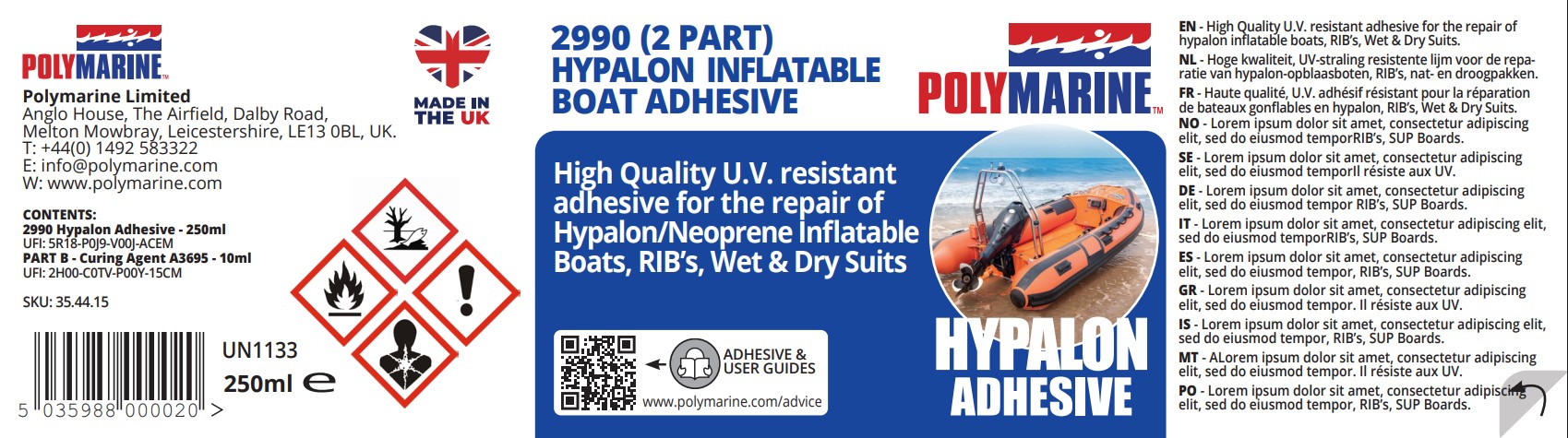
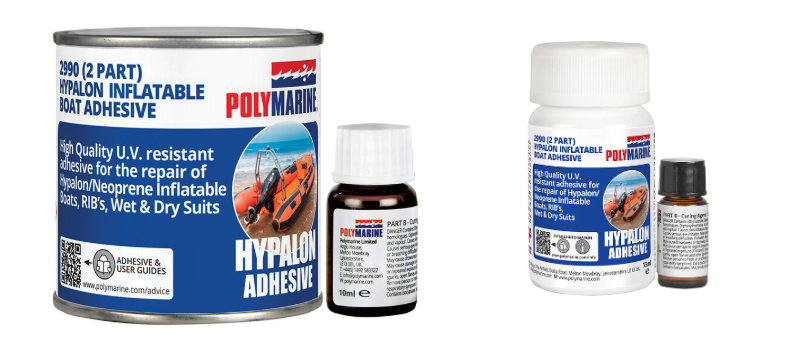
2990 Hypalon Adhesive, 2 Part, 250ml Tin
Polymarine 2 Part Hypalon Adhesive. Used by MOD, life-raft service stations and major manufacturers. Particularly suitable for manufacture and repair of inflatable boats made from Hypalon and Neoprene fabrics.
The most popular Hypalon glue that is used to repair Hypalon inflatable boats, and RIBs by boating enthusiasts.
Description
Hypalon Inflatable Boat Adhesive. Supplied with a 10ml bottle of A3695B Curative
* Solvent based polychloroprene rubber adhesive giving high strength bonds when used in conjunction with A3695B curing agent; particularly suitable for manufacture and repair of inflatable boats
* Will bond natural rubber, Polychloroprene, Butyl, Nitrile, Hypalon, Neoprene and polyurethane rubber materials and leather.
Please note – not for use on plasticised PVC – use Polymarine 3026 PVC Adhesive
* Excellent resistance to heat, salt water and humidity
* Easy to mix two part system supplied in sets with requisite amount of curing agent; can be used as a single part for quick temporary repairs
* Easy to apply by brush or roller…
* Contact bonds in 10-15 minutes, full cure 48 hours
* Shelf life – 24 months unopened tin, mixed adhesive has pot life of 3-4 hours
* Coverage – using 2 coats 1 litre bonds 1 square metre
* Use Polymarine 2903 Primer and cleaner to degrease and prepare surfaces before adhering.
* As used by MOD, life-raft service stations and major manufacturers.
Application:
1. Stir the adhesive well before adding the curative (ratio 25:1) to the adhesive and mix well.
2.Ensure surfaces are dry & abrade well. Wipe Clean with Polymarine 2903 Primer & Cleaner.
3.Brush first even coat of 2990 adhesive on both surfaces, allow to dry for minimum 30 minutes.
4.Apply second even coat to both surfaces, leave for 5 minutes or until tacky.
5.Bring surfaces together with as much pressure as possible.
TECHNICAL
1.Store between +5°C and +25°C.
2.Mixed pot life 4 hours.
3.Curing time 48 hours.
4.Maximum bond strength 7 days.
5.Clean brush with 2903 Primer & Cleaner.
Recommended:
POLYMARINE 2903 INFLATABLE BOAT PRIMER & CLEANER
For Priming and Cleaning both PVC and Hypalon Inflatable Boat Fabrics.
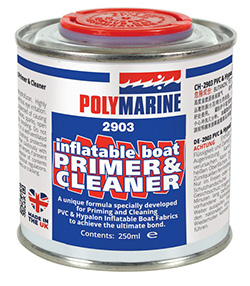 * A primer to degrease and prepare surfaces before adhering
* Use sparingly with a soft cloth, evaporates quickly
* Suitable for reactivating applied adhesive
* Contains Butanone (MEK)
* Suitable for cleaning brushes
2990 Hypalon Adhesive – 250ml
UFI: 5R18-P0J9-V00J-ACEM
DANGER Contains: BUTANONE, hydrocarbons, C6-C7,n-alkanes, isoalkanes, cyclics, <5% n-hexane
Hazard statements: Highly flammable liquid and vapour. Causes skin irritation. Causes serious eye irritation. May cause drowsiness or dizziness. Toxic to aquatic life with long lasting effects.
Precautionary Statements: Keep away from heat, hot surfaces, sparks, open flames and other ignition sources. No smoking. Do not breathe dust/fume/gas/mist/ vapours/spray. Use only outdoors or in a well-ventilated area. Avoid release to the environment. Wear protective gloves/protective clothing/eye protection/face protection. IF IN EYES: Rinse cautiously with water for several minutes. Remove contact lenses, if present and easy to do. Continue rinsing. Get medical advice/ attention. Dispose of contents/ container in accordance with national regulations.
PART B – Curing Agent A3695
UFI: 2H00-C0TV-P00Y-15CM
DANGER Contains: Ethyl acetate; Diphenylmethane Diisocyanate, isomers, homologues and Diphenylmethane -4,4 Di-isocyanate. Highly flammable liquid and vapour. Causes skin irritation. Causes serious eye irritation. May cause allergy or asthma symptoms or breathing difficulties if inhaled. May cause respiratory irritation. May cause drowsiness or dizziness. Suspected of causing cancer. May cause damage to organs (respiratory system) through prolonged or repeated exposure (if inhaled). Keep away from heat, hot surfaces, sparks, open flames and other ignition sources. No smoking. IF INHALED: Remove person to fresh air and keep comfortable for breathing. If experiencing respiratory symptoms: Call doctor. Store in a well-ventilated place. Keep cool. Contains isocyanates. May produce an allergic reaction. Persons already sensitised to diisocyanates may develop allergic reactions when using this product. Persons suffering from asthma, eczema or skin problems should avoid contact, including dermal contact, with this product. This product should not be used under conditions of poor ventilation unless a protective mask with an appropriate gas filter (i.e. type A1 according to standard EN 14387) is used.
IMPORTANT:
Before you start any gluing, please note:- your workplace needs to be well ventilated, warm and dry. If the air is humid, don’t try to use the adhesive, as it will bloom. Do not use a gas fire or naked flame heat source, as the solvents are highly flammable. Do not use the adhesive if it has been mixed for more than 4 hours.
MIXING:
Mix adhesive with Curative at the ratio of 25:1
The Curative supplied is in ratio with the adhesive, so half the curative and half the tin will also be 25:1
 REPAIRING A HOLE
If the damage to your tube is more than 75mm in any direction an ‘inside patch’ needs to be applied. The procedure is the same as for an Outside Patch but is made more difficult because you are working on the inside of the tube.
INSIDE PATCH
1. Mark out and cut your material to size. This should be big enough to cover the damage plus 30mm on every side.
Make sure that all the corners are rounded.
 2. Sand down the top surface on the patch until it is lightly abraded to a matt finish and the back surface of the tube is sanded until the surface starts to break up and looks like suede. Wipe the surface of the patch and the tube that is going to have the adhesive on with the Polymarine 2903 to degrease and prepare surfaces before adhering. Allow the solvent to flash off (evaporate). If you apply the adhesive to soon it will bloom (turn slightly white) the adhesive will need to be removed and new adhesive will have to be applied.
3. Mix half of the adhesive (2990 two part adhesive) as directed on the tin. Brush onto the surface thinly, the surface should look wet. Allow the adhesive to dry for at least 30 minutes.
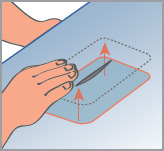 4. Apply second even coat of adhesive to both surfaces, leave for 5 minutes or until tacky. With the inside patch lay a piece of polythene onto the adhesive, so it can be rolled up and put through the hole. Place inside the tube and put into position, remove polythene. Work one side down with your Smoother, pressing hard, then work the other side. Work from the middle to the outside of the patch. You must make sure that there is no air trapped between the surfaces. Please note:- the adhesive is a contact type, as soon as it touches the other surface it will stick. Make sure that the patch is in the correct position before the surfaces come into contact.
5. Leave to dry for at least six hours.
6. When dry, pump up the chamber and check for air leaks. The inside patch must be air tight.
OUTSIDE PATCH 7. With the tube inflated prepare the outside of the tube and your outside patch. Using masking tape around the patch leaving about a 3mm gap to allow for stretch in the material.
8. Sand down the surface of the tube until it is lightly abraded to a matt finish, and sand the back of the patch until the surface starts to break up and looks like suede. Wipe both surfaces with Polymarine 2903 primer & cleaner. Mix the rest of the adhesive. Apply first coat of adhesive, leave for 30 minutes, apply second coat of adhesive. Leave for 5 minutes, or until tacky.
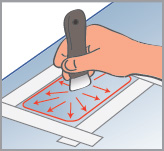 9. Put down the patch and rub down from the centre out with Roller or Smoothing tool. Check that all the edges are stuck down. You must make sure that there is no air trapped between the surfaces. Remove the tape and rub off any excess adhesive with Polymarine 2903 primer & cleaner. If the adhesive is left on, it will turn brown.

10. Leave to dry for at least six hours before putting pressure in the tube.
Full cure 48 hours. Maximum Bond Strength 7 days.
D Ring Patches & Accessories
Rubber, Hypalon and Neoprene accessories
can be glued with Hypalon Adhesive using a similar technique to the patch repairs.
1. Sand the surface of the Hypalon Inflatable where the accessory is to be glued until it is lightly abraded. Sand the accessory if Hypalon or Rubber.
2. The surfaces of the inflatable & accessory should be cleaned with the Hypalon Primer and Cleaner to remove any trace of finger oils or dust.
3. Paint both surfaces to be adhered with a thin coating of glue. Allow the adhesive to dry for at least 30 minutes.
4. Next spread a second thin even layer of adhesive on both pieces and leave 5 to 15 minutes until the surface is tacky to the touch.
5. Bring both together with as much pressure as possible. Rub the air out with Smoother. You may want to deflate the boat to assure a better bond for the accessory. It is critical to get all the air out from between the pad and the surface of the inflatable, and the pad is sealed completely around the edges.
6. Once the air is out from under the accessory, let it cure for 48 hours. Max bond strength 7 days.
Polymarine Ltd.
Anglo House,
The Airfield, Dalby Road,
Melton Mowbray,
Leicestershire,
LE13 0BL,
United Kingdom.
Tel: +44 (0)1492 583322
Email: info@polymarine.com


POLYMARINE™ LIMITED. Company number 01258709 (England & Wales). Registered office address; Anglo House, The Airfield, Dalby Road, Melton Mowbray, England, LE13 0BL.
Polymarine is a registered trademark No. UK00003609325